There’s a moment a lot of homeowners know well. You step outside, look up at the roof, and something’s off. A few bricks look shifted. A crack runs along the crown. Maybe there’s a faint stain trailing down the masonry after rain.
And the question lands: do I need a repair, or does this whole thing have to come down?
It’s not just a technical call. It’s a cost decision, a safety decision, and a peace-of-mind decision. Nobody wants to pay for the wrong fix — or ignore a problem that quietly gets more dangerous through the next freeze-thaw season.
Here’s how we think through it on the roof, in plain terms.
When a Small Crack Is More Than “Just a Crack”
Most chimney problems don’t start big. They start as a hairline crack in the crown, a loose brick near the top, a bit of mortar that’s let go after a storm.
At first it looks harmless. But masonry doesn’t heal. It absorbs water, the water freezes and expands, the gap widens, and the next rain gets in deeper. In Connecticut that cycle runs dozens of times every winter, which is exactly why upper-chimney damage here tends to accelerate faster than homeowners expect.
The early warning signs worth watching for:
- Thin vertical cracks through the bricks, especially near the roofline
- A chimney crown that’s started to flake, lift, or split
- Moisture or staining inside the firebox even when it hasn’t rained hard
- White, chalky residue (efflorescence) on the brick — a sign water is moving through the masonry
None of these means “rebuild” on its own. What they mean is: find out how deep it goes before you decide anything.
What a Real Inspection Usually Reveals
A lot of chimney damage looks minor from the ground and tells a completely different story up close. Cracks that read as cosmetic from the driveway often hide water intrusion, eroded mortar joints, or crown damage that runs deeper into the structure.
That’s why a proper inspection looks past the visible brick. We evaluate the crown, the flashing, the mortar joints, the flue liner, and the overall structural stability — because those are the parts that decide whether a repair will hold or just buy a season. The Chimney Safety Institute of America defines three inspection levels for exactly this reason, with a Level 1 covering readily accessible areas and a Level 2 going further when there’s reason to look closer.
Chimney Repair: When the Structure Can Still Be Saved
Not every chimney problem is a demolition story. Caught early, most fall squarely into repair territory.
Repair is the right call when the structure underneath is still sound and the damage is isolated. The general approach is always the same: stabilize the structure, stop water getting in, and restore the damaged sections before they spread. Common repair scenarios:
- Crown repair — patching or resurfacing the sloped concrete top so water stops entering the masonry below.
- Cap replacement — swapping the protective top cover when it’s damaged but the stack beneath is stable.
- Repointing — grinding out failed mortar joints and replacing them with fresh mortar to restore strength.
- Flue liner repair or relining — reinforcing or replacing the internal lining. This one is sensitive because the liner controls ventilation and directly affects safety, so it’s not a DIY area.
The principle is simple: if the structure is still stable, repair is the first and most cost-effective step.
When Repair Isn’t Enough Anymore
There’s a point where patching stops being a solution and becomes a delay.
You’ve crossed that line when you’re seeing cracking across multiple sides of the chimney, a stack that’s leaning or shifting, or brick that’s spalling — breaking apart and flaking — across large sections. A full or partial rebuild is the honest answer when:
- Bricks are spalling or crumbling across wide areas
- Mortar has eroded so badly the stack has lost structural strength
- Repeated repairs keep failing because the base or foundation is compromised
Material matters here too. A concrete-block chimney ages, cracks, and fails differently than brick, so a fix that works on one isn’t automatically right for the other. At this stage, trying to spot-repair won’t hold for long — the structure needs rebuilding from a stronger base.
Repair vs Replacement: The Real Difference
The simplest way to hold the distinction:
Repair fixes the symptoms. Replacement fixes the structure.
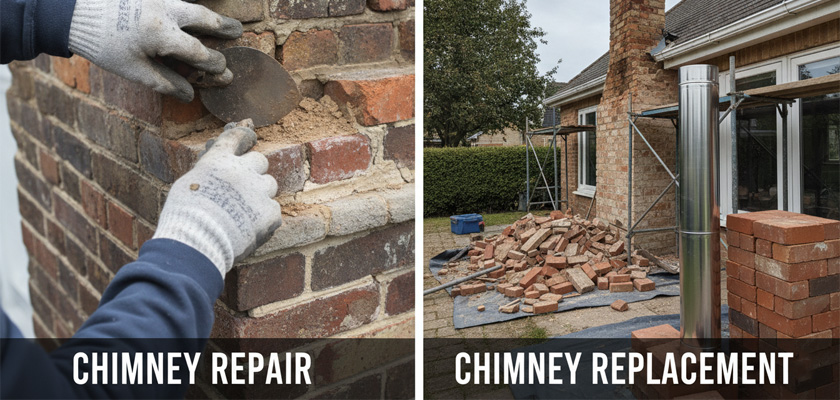
A repair addresses a cracked crown, seals leaks, or swaps a few damaged bricks. A rebuild removes and reconstructs the stack — sometimes just the portion above the roofline, sometimes the whole thing. Which one you need comes down to how far the damage has gone, not what’s cheapest this month.
What Chimney Work Actually Costs
Costs vary with height, damage, materials, and roof access — but “it varies” isn’t a helpful answer on its own, so here are real 2026 ballpark ranges to set expectations. (These are U.S. national averages; SERVICE AREA tends to run at or slightly above these because of freeze-thaw wear and roof access. Your exact number comes from an on-site look.)
| Job | Typical 2026 range |
| Level 1 inspection | $100 – $250 |
| Minor crack / mortar sealing | $150 – $750 |
| Crown repair (sound crown, surface cracks) | $150 – $700 |
| Full crown rebuild (failed crown) | up to ~$3,000 |
| Chimney cap replacement | $200 – $850 |
| Flashing repair | $300 – $1,800 |
| Waterproofing / sealing | $150 – $500 |
| Repointing / tuckpointing | $500 – $3,000 |
| Flue liner repair or replacement | $500 – $7,500 (stainless steel ~$2,000 – $3,500) |
| Leaning-chimney stabilization | $2,000 – $4,000 |
| Partial rebuild — above roofline | $1,000 – $3,500 (≈ $100 – $300 per linear foot) |
| Full rebuild — above + below roofline | $4,000 – $15,000+ |
A partial rebuild above the roofline costs less than a full structural rebuild because the lower portion and foundation stay intact. What moves the number most: chimney height, how much masonry has deteriorated, roof accessibility (steep or tall stacks need scaffolding or a lift), the brick or block type, and whether the flue liner also needs replacing.
The reason an on-site inspection matters is that two chimneys with identical-looking damage can need very different work once the underlying structure is assessed.
Cost vs Safety: The Decision Most Homeowners Wrestle With
It’s easy to fixate on price. But a chimney decision isn’t only financial — it’s a structural safety decision.
A failing chimney rarely collapses dramatically. More often it deteriorates slowly: moisture works into the home, surrounding roofing weakens, and a cracked or deteriorated flue liner becomes a real fire and carbon-monoxide hazard, because the liner is what keeps heat and combustion gases from reaching your home’s structure and living space.
That’s why “how much does a rebuild cost” should always be weighed against condition, not budget alone. Plenty of homeowners spend more over several years on repeated patches than a proper rebuild would have cost up front.
A Simple Way to Decide
If you’re standing between repair and replacement, here’s the practical test:
- If the damage is isolated, surface-level, and the chimney is structurally stable — repair is usually enough.
- If the damage is widespread, recurring, or affecting structural integrity — a rebuild is the safer long-term call.
That’s the real answer behind repair vs replacement. It’s not about which is cheaper today; it’s about which prevents a bigger cost tomorrow.
At a Glance
| Situation | Repair may be enough | Rebuild may be needed |
| Minor crown cracks | ✓ | |
| Small mortar joint deterioration | ✓ | |
| Isolated brick damage | ✓ | |
| Leaning chimney | ✓ | |
| Widespread spalling brick | ✓ | |
| Recurring structural cracks | ✓ | |
| Failed previous repairs | ✓ | |
| Significant water damage throughout the stack | ✓ |
Don’t Guess — Diagnose First
A chimney can look “a little damaged” for years before it suddenly isn’t. That’s what makes this tricky. The crack you ignore today might become a full rebuild later — or it might be a simple cap replacement that takes an afternoon. The difference is knowing what you’re actually looking at.
If you’re unsure whether you need a repair or a rebuild, the smartest move isn’t guessing. It’s an honest inspection and a straight assessment of the structure. When it comes to chimneys, timing matters as much as technique — and the right decision is almost always the one made before the damage spreads.
FAQs
How much does it cost to rebuild a chimney?
It depends on how much of the structure is involved. A rebuild above the roofline typically runs $1,000–$3,500 because the foundation and interior stay intact, while a full rebuild from the ground up runs $4,000–$15,000 or more. Height, brick type, roof access, and whether the flue liner needs replacing all move the number — so the only reliable figure comes from an on-site inspection.
How do I repair cracks in a brick chimney?
For minor damage, the process is to grind out the failing mortar joint, repoint it with fresh mortar, and seal the surface against water. The important caveat: if cracks span multiple bricks or keep returning each season, that points to a structural issue repointing won’t fix — and it’s worth a professional look before you spend money on a patch.
How do you repair a cracked chimney crown?
A crown with hairline surface cracks on an otherwise sound slab can be patched and sealed with a crown coat. A crown that’s crumbling, split through, or lifting off the brick generally needs to be recast — demolished and poured fresh with a proper drip-edge overhang. The goal either way is to stop water from reaching the masonry below.
How do you repair a cracked chimney cap?
It depends on the material. A metal cap with a damaged screen or weld can often be patched or swapped out; a cracked concrete cap is sealed or replaced. It’s a straightforward fix as long as the stack beneath it is still sound.
Can a cracked chimney flue be repaired, or does it need replacing?
Often it can be repaired — minor flue cracks are sometimes resolved with relining or sealing rather than a full rebuild. But because the flue controls ventilation and directly affects fire and carbon-monoxide safety, this is one area to leave to a professional inspection rather than a DIY patch.
Is it cheaper to repair or replace a chimney?
In the short term, repair almost always wins. But if the damage is widespread or keeps recurring, repeated repairs can add up to more than a single rebuild would have cost. The cheapest option over the life of the chimney is the one that matches its actual condition — which is why diagnosis comes before any cost decision.